

Residential EV charging – what happens next?
In 15 July 2019 a Consultation proposing that new-build homes are fitted with an electric car chargepoint was launched by Department for Transport, Office for Low Emission Vehicles, and The Rt Hon Chris Grayling MP
The consultation came alongside a package of announcements to support electric vehicle drivers and improve the experience of charging, with the aim of:
“Supporting and encouraging the growing uptake of electric vehicles within the UK by ensuring that all new homes with a dedicated car parking space are built with an electric chargepoint, making charging easier, cheaper and more convenient for drivers.”
In November 2021 the Consultation Response was published.
Existing parking schemes
Whilst the regulations pertaining to existing residential developments have been put back by six months for further consultation, what is clear is that in the next few years, current residential car parks are going to require significant changes in the way that they are operated.
Future residential developments
What is known is that new building regulations will come into play from June 2022 for new builds. This stipulates the that new residential buildings with associated parking must have access to EVCP, with one per residence that has a parking space.
Understanding the landscape
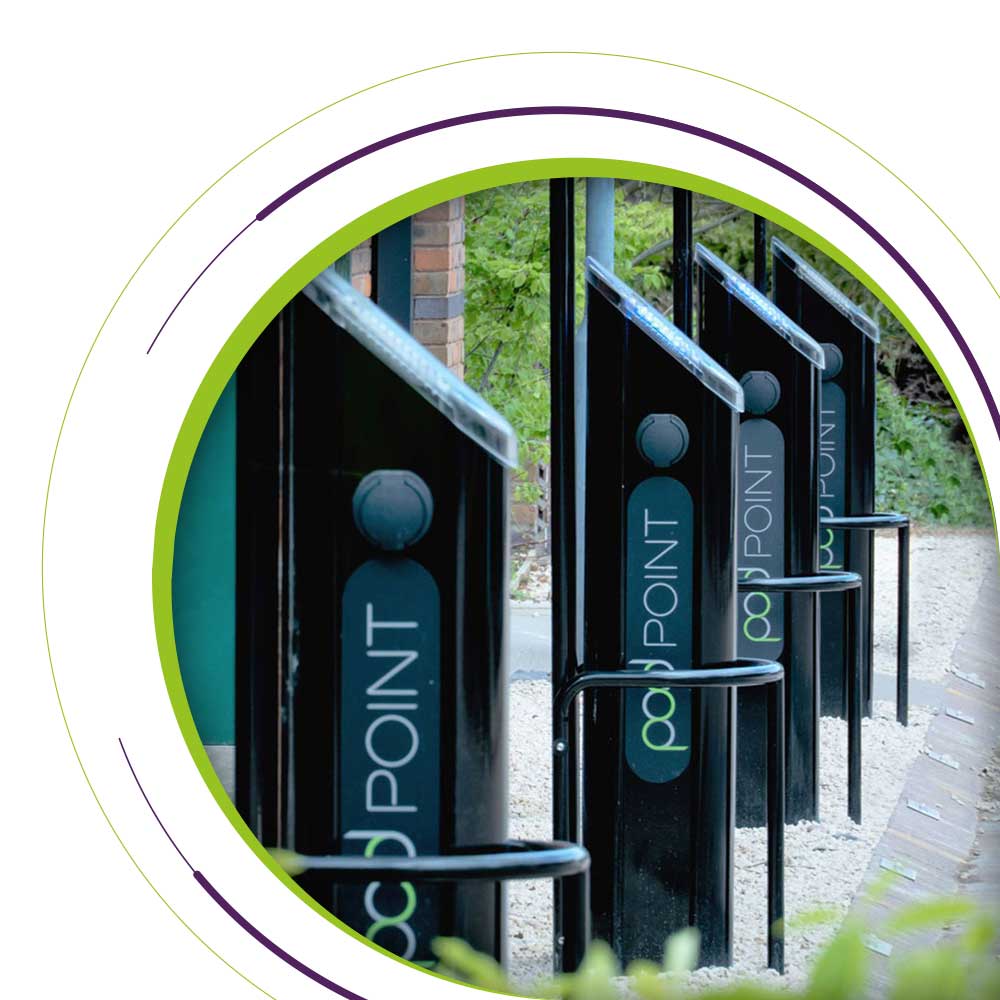
Late 2021 PCM approached the UK’s biggest residential charge point company, Pod Point. With a 60% share of the residential charge point sector Pod Point have a complete understanding of the challenges facing residential developments, regarding the installation of charge points in shared accommodation. A still relevant 2020 white paper makes a very good introduction to who they are and how they can help.
Understanding the vernacular!
EV charging comes with it’s own set of acronyms to learn. Pod Point have thoughtfully written a dictionary, so that people from outside the EV world can understand what they are talking about – find it HERE.
And this “About EV zones” page is also an interesting read.
Operational Challenges
So, what are the operational challenges exactly?
Abuse of EVCPs usually falls into one of three categories:
Unless your car can make use of a charging point then a charging bay is not for you. Parking an “Internal Combustion Engined” (ICE) car in a charging bay is known as “ICEing”. It frequently occurs most commonly where there is a lack of education surrounding EV Charging Bays (and lack of signage and proper deterrents). You do of course still get individuals who know exactly what they are doing and still do it regardless.
Even if it is a preferable space, those parking by the EV chargepoint should only park in the bay if they are going to charge. When at a public chargepoint, it’s also considerate to move once the individual has completed charging to allow another driver use of the chargepoint.
We have seen this at numerous sites where certain providers install charging units that have no way to log usage and therefore who to bill for that usage. Wherever these charging units are set up, it is of utmost importance that a secure and reliable PAYG functionality is available with the system.
How can PCM Help?
From talking to some of our key clients, we quickly learned that “management of EV bays”, was not at the forefront of our clients’ minds – they were facing the more pressing problem of understanding the published regulations and their implications implications with regards to timelines and installation requirements.
But, once those headaches have been solved, the problem of ongoing EV Bay management and enforcement still remains.
With 20 years of car park management behind us, PCM can help with many aspects of EVCP abuse and we are evolving our approach as the technology changes, but to see how we can help right now, CLICK HERE.